The Tristero’s clandestine exile
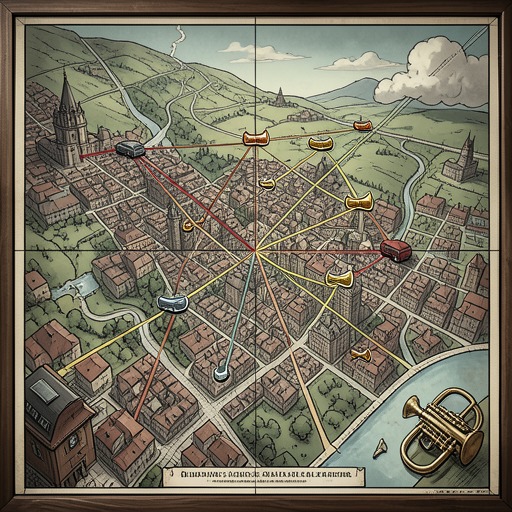
The Crying of Lot 49The Tristero’s clandestine exile is the organization’s shift from a public claim to inheritance into a covert life on the margins of official communication. Its story joins aristocratic dispossession, clandestine resistance to the Thurn and Taxis monopoly, and adaptation to American postal suppression; in Oedipa’s investigation, that history offers a possible explanation for the muted post horn and the secret carriers she encounters, but never settles whether the network is real in the form she imagines.
Dispossession and the black emblem
After Jan Hinckart was dispossessed and the Thurn and Taxis Grand Master Leonard I reinstated, the postal monopoly was weakened by political instability and financial losses. Tristero’s own system appears to have emerged from this opening. He styled himself El Desheredado, “The Disinherited,” claiming the postal monopoly for Ohain by right of conquest and Ohain for himself by blood. His followers wore black to signify the night that, in their exile, was the only thing they could call their own.
The organization’s visual language made that claim portable. Tristero adopted the muted post horn and a dead badger with all four feet in the air; the account associates the badger with a possible Italian origin of the name Taxis and the fur hats of early Bergamascan couriers. Its emblems turn a disputed inheritance into a recognizable sign, one that can recur long after the original claimants have disappeared from public view.
From open revolt to clandestine obstruction
Tristero’s early response to the weakened monopoly was a covert campaign of obstruction, terror, and depredation along Thurn and Taxis mail routes. This was not merely a rival service operating openly beside the established one: the account presents it as a campaign conducted in the shadows against the routes and authority of the postal system it opposed.
The organization’s later history includes a rupture within its own ranks. During the French Revolution, one faction wanted to help Thurn and Taxis weather its troubles, regarding the passing of the Holy Roman Empire as temporary and treating support for the house as a duty between aristocrats. The proposal to subsidize the postal family split the organization at a Milan convention, where arguments lasted a week, families divided, enmities hardened, and blood was shed. The proposal failed; many conservatives left, interpreting the result as a judgment against them. The account describes the ensuing years as an eclipse: Tristero lost much of the noble patronage that had sustained it and was reduced to carrying anarchist correspondence, with only peripheral involvement in European revolutionary movements.
Exile in the United States
The greatest number of Tristero members reportedly fled to America in 1849–50. Their arrival coincided with an inhospitable communications landscape. Around 1845, the United States had lowered postal rates and driven many independent routes out of business; by the 1870s and 1880s, independent carriers attempting to compete with the government were quickly suppressed. In the history discussed by Mike Fallopian, those reforms connect postal administration to a broader struggle over political power and the survival of private delivery.
According to Emory Bortz’s account, the émigrés therefore remained in the United States not as a visible competing postal institution but within a conspiracy. By 1861, the organization was said to be established enough to evade suppression. While the Pony Express crossed the western deserts, Tristero messengers allegedly learned Siouan and Athapascan dialects, disguised themselves as Indigenous people, and traveled west with no losses. The contrast is pointed: where a celebrated carrier’s identity and route are public, Tristero’s methods rely on silence, impersonation, and opposition disguised as allegiance.
Signs, carriers, and uncertain inheritance
Oedipa’s encounters give this history a contemporary set of possible traces. A notice in a restroom directs people seeking discreet correspondence to contact Kirby through W.A.S.T.E.; beneath it is a strange mark that Oedipa copies. At Yoyodyne, she uses the name Kirby as a tentative approach to Stanley Koteks, whom she finds drawing the same kind of sign. Later, Genghis Cohen identifies the mark as a watermark on a stamp, and the historical account connects the muted post horn to Tristero’s emblem. These recurrences suggest a system of recognition, though they do not independently establish who controls it or how its separate appearances are connected.
The postal network is also presented through actual acts of delivery. In San Francisco, Oedipa puts a sailor’s letter into a green, nearly four-foot-high container marked W.A.S.T.E. She watches a young man collect the letters, follows him as he exchanges sacks with another carrier, and trails him through Oakland to Berkeley. The route makes the organization’s supposed method concrete—distributed collection, handoffs, and a concealed delivery chain—while leaving the carrier’s larger affiliations unconfirmed.
The history’s reach expands again when Oedipa considers the people at the edges of American life: squatters in abandoned rail cars, people living beside highways or in wrecked vehicles, and drifters who seem exiled within the country itself. She wonders whether some share the Tristero’s secret and its inheritance of disinheritance. In that possibility, the organization is more than a remnant of an aristocratic postal quarrel: it becomes a name for those left outside the official channels through which the nation recognizes and connects its inhabitants.
The estate and the limits of certainty
That expansive possibility is also what makes the Tristero difficult for Oedipa to distinguish from a plot. She discovers that places associated with her investigation, including the shopping center containing Zapf’s Used Books and the Tank Theatre, belonged to Pierce Inverarity. Emory Bortz’s college is heavily endowed by the dead man as well. Oedipa consequently considers whether the people and clues she has encountered are all Inverarity’s agents, recruited for a practical joke or some other design. Every apparent route toward the Tristero can also be traced back to the estate.
The organization’s exile thus remains both a historical account and an interpretive possibility. Its past offers a coherent pattern of dispossession, postal monopoly, covert resistance, and American survival; its present-day signs appear across letters, stamps, people, and places. But the evidence does not dissolve Oedipa’s alternatives: the network may be a genuine continuation of an underground tradition, a construction tied to Inverarity, or a pattern she has assembled from coincidences. The unresolved question is integral to its significance: a hidden system may preserve communication for the excluded, yet the very secrecy that allows it to endure also makes its existence and inheritance impossible to verify with confidence.